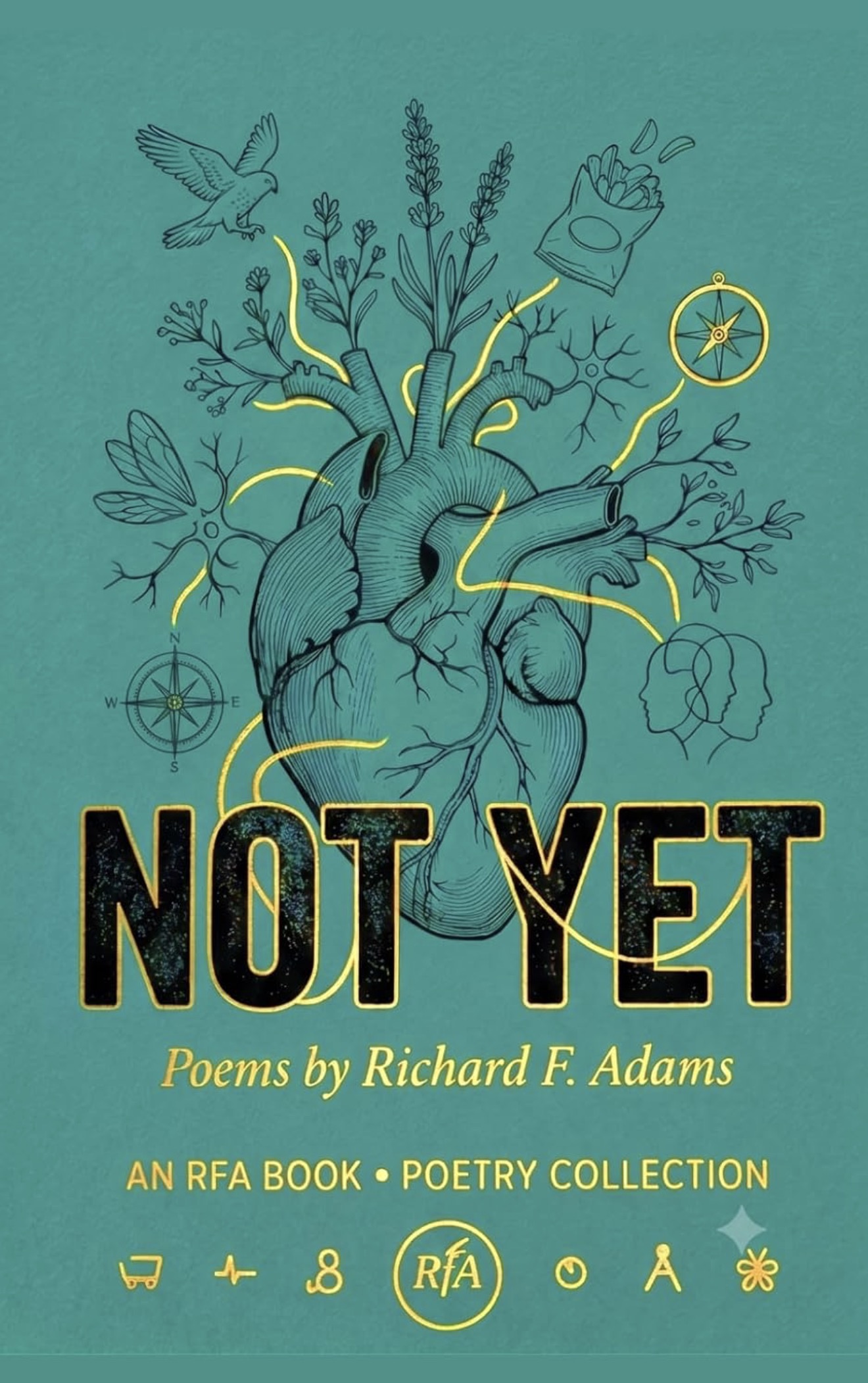
Poems by Richard F. Adams
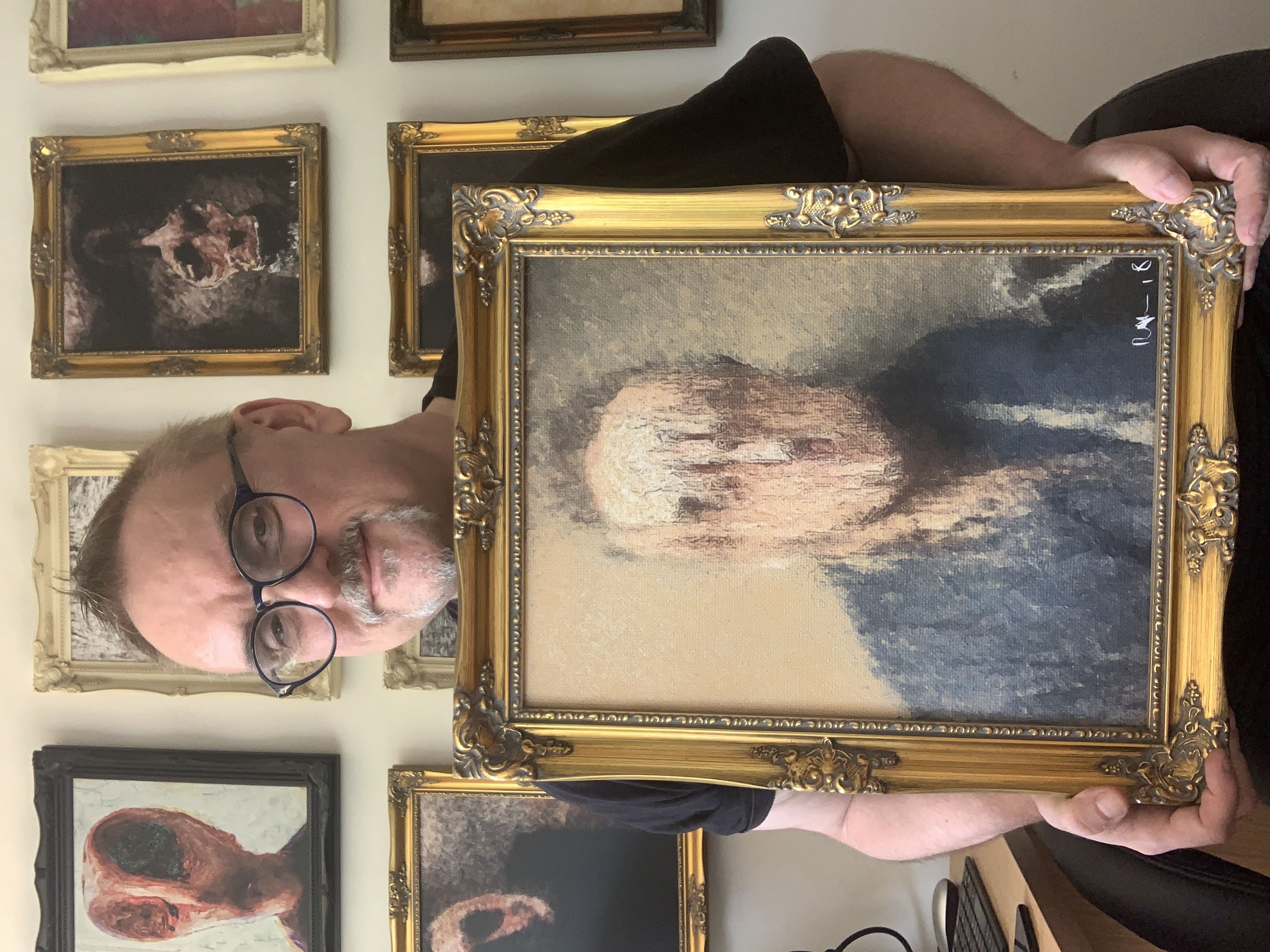
Ten in the morning, on an NHS ward, the poet’s heart stopped. Someone on a twelve-hour shift knew what to do with her hands. Nobody asked what he was worth first.
Not Yet is a first collection, written over fifteen years — in hospitals, on trains, and in the ordinary hours when something insisted on being written down and wouldn’t take a polite no. These are poems built from scenes rather than arguments: coffee shops, supermarkets, chip shops, train platforms, hospital corridors, Barnsley backyards and Weybridge drives.
It begins in the town that made him. Defoe called Barnsley black for its soot; it stands now in glass, built over the capped shafts of the pits that paid for it. From there the book moves through a Yorkshire childhood — a Triang bike, a father who never said much to your face but never stopped bragging about you in the working men’s club, a system of affection that took forty years to decode. Then out to the clipped lawns and idling engines of the commuter belt, the interview room, the supermarket aisle. And finally back to the ward.
The range is wide and not always solemn. There are sonnets, free verse and poems in broad Yorkshire. There is a mock-scholarly critical edition of Kubla Khan set in a Tesco Express. There is a long poem about the NHS that doesn’t argue its case so much as leave it on your doorstep and ring the bell. There is a red-and-white cat who knew what was coming a week before he went, and had the good manners not to mention it.
At the centre is death — not as metaphor, which is how poetry usually prefers it, safely on a leash, but as something witnessed, endured and returned from.
Not Yet is for anyone who has sat in a waiting room and not known how it ends. For anyone who has lost a parent and found themselves promoted, without interview, to a different place in the world. For anyone who has wondered what it actually means to still be here, and would quite like the answer before closing time.
Direct, dry, occasionally furious, and unwilling to look away.